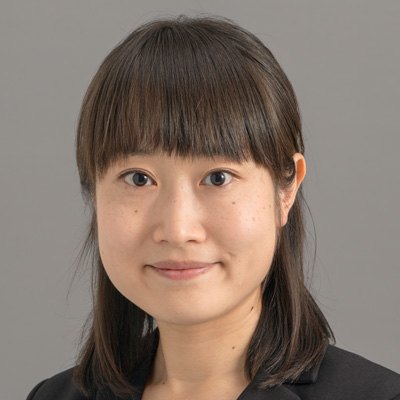
Fujioka, Satoko

写真a

Affiliation

Faculty of Science and Technology, Department of Applied Chemistry ( Yagami )

Position

Associate Professor

External Links

Career 【 Display / hide

  • 2009.04
    -
    2010.03

    慶應義塾大学特別研究助教(先導研究センター)

  • 2010.04
    -
    2013.03

    慶應義塾大学助教(有期)(理工学部応用化学科)

  • 2010.04
    -
    2013.03

    Keio University, Faculty of Science and Technology Department of Applied Chemistry, Assistant Professor

  • 2010.07
    -
    2010.08

    Technical University of Hamburg, Institute of Multiphase Flows, Visiting Scientist

  • 2012.02
    -
    2012.03

    株式会社カネカ嘱託研究員

display all >>

Academic Background 【 Display / hide

  • 1999.04
    -
    2003.03

    Tokyo Institute of Technology, 工学部, 化学工学科

  • 2003.03

    Tokyo Institute of Technology, Faculty of Engineering, Deparement of Chemical Engineering

    University, Graduated

  • 2005.04

    Tokyo Institute of Technology, Graduate School, Division of Science and Engineering, Department of Chemical Engineering

    Graduate School, Completed, Master's course

  • 2008.07
    -
    2009.07

    ÉCOLE SUPÉRIEURE DE PHYSIQUE ET DE CHIMIE INDUSTRIELLES DE LA VILLE DE PARIS

  • 2009.03

    Tokyo Institute of Technology, Graduate School, Division of Science and Engineerig, Department of Chemical Engineering

    Graduate School, Completed, Doctoral course

Academic Degrees 【 Display / hide

  • 博士(工学), Tokyo Institute of Technology, Coursework, 2009.03


Research Areas 【 Display / hide

  • Manufacturing Technology (Mechanical Engineering, Electrical and Electronic Engineering, Chemical Engineering) / Fluid engineering

  • Manufacturing Technology (Mechanical Engineering, Electrical and Electronic Engineering, Chemical Engineering) / Fluid engineering (スラグ流、マイクロバブル、混相流、レオロジー)

  • Manufacturing Technology (Mechanical Engineering, Electrical and Electronic Engineering, Chemical Engineering) / Transport phenomena and unit operations

  • Manufacturing Technology (Mechanical Engineering, Electrical and Electronic Engineering, Chemical Engineering) / Chemical reaction and process system engineering (Reaction Engineering/Process System)

Research Keywords 【 Display / hide

  • slug flow, fine bubble, multiphase flow, Process Intensification


Books 【 Display / hide

  • ファインケミカル, 医薬品の連続生産プロセス

    技術情報協会, 技術情報協会, 2024.11,  Page: 610p

    Scope: 第1章第17節 液液スラグフローリアクターによる微粒子およびゲルビーズの連続製造

  • 進化するファインバブル技術と応用展開 (最近の化学工学70)

    ファインバブル学会連合, ファインバブル学会連合, 化学工学会 関東支部, 2022.03,  Page: 258

    Scope: 第9章 マイクロバブル界面における物質移動

  • 持続可能な社会への道 -環境科学から目指すゴール-

    2020.10

    Scope: 第6章環境課題解決のための生産技術と社会実装,  Contact page: p.183-197

  • 持続可能な社会への道─ 環境科学から目指すゴール ─ (学術会議叢書27)

    大政 謙次 / 阿尻 雅文 / 北川 尚美 / 青野 光子 / 吉田 丈人 / 平野 高司 / 小﨑 隆, 羽島 知洋 / 真木 太一 / 所 千晴 / 後藤 雅宏 / 宮崎 あかね / 和田 元 / 藤岡 惠子 / 桑野 園子, 谷 晃 / 平尾 雅彦 / 野田 優 / 藤岡 沙都子 / 花木 啓祐 / 碓井 照子 / 山極 壽一, 日本学術協力財団, 2020.10,  Page: 264

    Scope: 第6章 環境課題解決のための生産技術と社会実装

Papers 【 Display / hide

  • A Numerically Stable Sequential Model for Estimating Shear Rheological Parameters of Food Fluids

    Ikeda N., Kimoto A., Fujioka S., Terasaka K.

    Journal of Food Process Engineering 49 ( 2 )  2026.02

    Joint Work,  ISSN  01458876

     View Summary

    This study aims to improve the numerical stability of rheological parameter estimation for non-Newtonian food fluids by proposing a Sequential Herschel–Bulkley (SHB) model, which sequentially estimates yield stress (τ<inf>0</inf>), consistency index (K), and flow behavior index (n) using pressure drop and flow rate data obtained from tube flow. In contrast to the conventional Herschel–Bulkley (HB) model, which fits all three parameters simultaneously and is susceptible to numerical instability, the SHB model first determines τ<inf>0</inf> using the Casson equation and then fits K and n with τ<inf>0</inf> fixed. The method was validated using tamarind seed gum (TG) solution, xanthan gum (XG) solution, and ketchup. Flow curves derived from SHB-based tube-flow measurements showed improved agreement with rotational viscometer data, particularly for ketchup, where the mean absolute percentage error (MAPE) decreased from 4.49% for the HB model to 2.10% for the SHB model. In addition, repeated nonlinear fitting demonstrated that the SHB model consistently reduced the coefficients of variation and parameter variances relative to the HB model, indicating enhanced robustness. These findings demonstrate that the SHB model provides a concise, reliable, and numerically stable approach for estimating shear rheological parameters of yield-stress food fluids using practical in-line measurement signals.

  • Evaluation of Laminar Mixing Performance in an Oscillatory Baffled Reactor: Experimental and Numerical Approaches

    Murotani R., Saiki W., Fujioka S., Yasuda M., Horie T.

    Journal of Advanced Manufacturing and Processing 7 ( 4 )  2025.10

    Joint Work

     View Summary

    In regions with a low oscillatory Reynolds number, an oscillatory baffled reactor (OBR) exhibits the folding and stretching of fluid, resulting in the mixing observed within the baffle sections. In this study, an analysis of the mixing mechanism and an evaluation of mixing performance were conducted using experimental methods and numerical simulations to visualize the boundary between the liquid phases and track its shape changes. The ratio of oscillation stroke to baffle interval length, the open ratio of the baffle's cross-sectional area, and the length of the baffle intervals were varied. A glycerin-water solution was used, and the boundary line was colored with rhodamine, forming a film-like layer at the orifice, which was then visualized using sheet laser fluorescence. Oscillatory flow was applied, and changes in the length of the boundary line and the boundary area were measured for one oscillation cycle. For the numerical calculations, the velocity field was first computed, followed by the arrangement of virtual particles to represent the boundary line. The shape of the boundary line obtained from the experiments was consistent with the simulation results, and the trends in the length of the boundary lines for the first cycle were generally consistent as well. Therefore, the experimental results confirmed that the boundary area increases exponentially, consistent with the simulation results.

  • Application of the approximate mapping method and validation of the mixing evaluation method based on fractal dimension in an oscillatory baffled reactor

    Ryosuke Murotani, Takafumi Horie, Satoko Fujioka, Erika Okita, Masahiro Yasuda

    Chemical Engineering and Processing - Process Intensification (Elsevier BV)  212   110279 - 110279 2025.06

    Joint Work,  ISSN  02552701

     View Summary

    An approximate mapping method was applied and validated to predict the mixing state of an oscillatory baffled reactor in the low oscillatory Reynolds number regime. In addition, a fractal dimension method using mapping images for mixing performance evaluation was validated. The Poincaré maps approximated by Shepard's method were employed for the predictions. The results were well-matched when comparing fluid deformation and the mixing performance with the mapping method and direct numerical calculations based on virtual particle tracing, with the relative error being small at less than 1.5%. Using the mapping method, the computational time required for CFD was reduced, and the total time for the entire process up to the evaluation of mixing performance was reduced to two-thirds. Moreover, the results of the mixing performance evaluation using the fractal dimension were consistent with those obtained from a standard method. It was shown that the mixing performance evaluation through simple image analysis, based on the mixing enhancement mechanisms of laminar flow, is feasible.

  • Flow Analysis of Self-Induced Sloshing Caused by Bubbly Flow and Its Effect on Mass Transfer

    Fujioka S., Ochiai Y., Fujita E., Terasaka K.

    Bunseki Kagaku 74 ( 12 ) 771 - 776 2025

    Joint Work,  ISSN  05251931

     View Summary

    This study aimed to investigate the effect of self-excited sloshing, induced by a bubble plume, on mass transfer. In a rectangular tank, experiments were conducted by intentionally varying the bubble diameter using different gas spargers and by adding 1-butanol to the liquid phase. The characteristics of the liquid surface oscillation and the mass transfer coefficient k<inf>L</inf> were measured. The results showed that decreasing the bubble diameter promoted sloshing and increased its amplitude. However, a further reduction in bubble size through the addition of 1-butanol suppressed the oscillation. This was attributed to the formation of a foam layer, which dissipated energy through friction with the tank walls. Regarding mass transfer, the mass transfer coefficient k<inf>L</inf> tended to increase with the gas flow rate, suggesting that sloshing could potentially enhance mass transfer. Nevertheless, no simple correlation was found between the sloshing amplitude and the value of k<inf>L</inf>. The study concludes that bubble diameter and liquid properties significantly alter sloshing characteristics, but further detailed investigation, including the improvement of CFD predictions, is required to fully elucidate the relationship between the fluid dynamics and mass transfer.

  • A Simplified Model for Predicting Changes to Ultrafine Bubble Size Distributions under Flowing Conditions

    Kurumi NAKAJIMA, Hanako SASAKI, Adam DONALDSON, Koichi TERASAKA, Satoko FUJIOKA

    JAPANESE JOURNAL OF MULTIPHASE FLOW (The Japanese Society for Multiphase Flow)  38 ( 3 ) 281 - 288 2024.09

    Joint Work, Accepted,  ISSN  0914-2843

display all >>

Papers, etc., Registered in KOARA 【 Display / hide

display all >>

Reviews, Commentaries, etc. 【 Display / hide

display all >>

Presentations 【 Display / hide

  • 気泡流による自励スロッシングに及ぼす液物性の影響

    藤田えりか,藤岡沙都子,寺坂宏一

    [Domestic presentation]  化学工学会3支部合同大会(秋田大会), 

    2021.07

    Oral presentation (general)

  • 振動流バッフル反応器における低レイノルズ数領域での内部流動解析

    鈴木博己,藤岡沙都子,堀江孝史,薬師寺光,寺坂宏一

    [Domestic presentation]  化学工学会3支部合同大会(秋大会), 

    2021.07

    Oral presentation (general)

  • 液液スラグ流におけるスラグ長さの推算と内部循環流の可視化

    手塚智哉,藤岡沙都子,寺坂宏一

    [Domestic presentation]  化学工学会3支部合同大会(秋田大会), 

    2021.07

    Oral presentation (general)

  • 固液分散プロセスへの応用を目指した振動流バッフル反応器の内部流動解析

    野本大智,藤岡沙都子,堀江孝史,薬師寺光,寺坂宏一

    [Domestic presentation]  化学工学会3支部合同大会(秋田大会), 

    2021.07

    Oral presentation (general)

  • 難溶性薬物の過飽和溶液の安定性に対するウルトラファインバブルの影響

    木村 早百合,今岡 鮎子,秋好 健志,田中 俊也,藤岡 沙都子,寺坂 宏一,大谷 壽一

    [Domestic presentation]  日本医療薬学会第4回フレッシャーズ・カンファランス, 

    2021.06

    Oral presentation (general)

display all >>

Research Projects of Competitive Funds, etc. 【 Display / hide

  • Elucidation of Non-steady Vortex Flow Dynamics in Transitional Regime and its Application to Chemical Reaction Process Intensification.

    2025.04
    -
    2029.03

    Grants-in-Aid for Scientific Research, Grant-in-Aid for Scientific Research (B), No Setting

     View Summary

    振動流バッフル反応器は,バッチ式撹拌槽型プロセスを流通式管型へと転換できるため,化学プロセスの飛躍的高効率化への貢献が期待されている。しかし,大きな渦流がランダムに多数発生する反応器内の流動は複雑であり,その混合及び物質移動強化の発現要因は明らかになっていない。そこで,内部流動観察や数値流体シミュレーション結果に基づいて特徴的な渦流構造とそのダイナミクスを定量評価し,混合及び物質移動性能強化との関係を明らかにする。

  • Development of a flow prediction model for the design of liquid-liquid slug flow reactor utilization processes

    2024.04
    -
    2027.03

    Japan Society for the Promotion of Science, Grants-in-Aid for Scientific Research, Grant-in-Aid for Scientific Research (C), Principal investigator

     View Summary

    「液液スラグフローリアクター活用プロセス設計のための流動予測モデル」を開発する。二流体が管内を交互に流れる液液スラグ流は、内部循環流による混合促進効果により優れた反応・分離場になると期待される。しかし、液物性や操作条件、装置条件により変化する流動状態の迅速な予測は困難である。そこで機械学習を用いた液液二相流動状態の予測モデルを構築し、スラグ流活用のための迅速な操作条件決定を可能にする。
    マイクロ・ミリスケール流路内の液液二相流は、反応場や分離場、特に混合性能に優れるスラグ流の利用が期待されている。しかし、多様な流体や流路条件(材質、形状)が存在するため、任意の条件に適用可能な普遍的な流動状態(液滴流、スラグ流、環状流)の予測モデルは未確立である。キャピラリー数とレイノルズ数を用いた従来の無次元数マップは存在するものの、流路の濡れ性や合流角度、材質、断面形状といった要因を考慮できず、異なる実験条件では予測精度が大きく変動するという課題があった。
    そこで本研究では、機械学習、特にニューラルネットワーク技術を活用し、より広範な条件に対応可能な流動状態予測モデルの構築を目指した。モデルの入力変数には、界面張力、分散相と連続相それぞれの粘度と密度、管径、二流体の合流角度、壁面の接触角という計8つの物理的・幾何学的パラメータを採用した。出力は各流動状態(液滴流、スラグ流、環状流)の確率とした。学習と検証には、既往の4つの論文から抽出したデータと本研究グループの実験データを合わせた計3577点のデータセットを使用した。
    ランダムに抽出したデータで学習・検証を行った結果、構築したモデルは約78%の正答率を達成し、特に重要なスラグ流とそれ以外の判別においてもF1値約0.76と、偏りの少ない良好な予測性能を示した。一方で、特定の流路条件の影響を評価するため、矩形管やガラス管のデータを意図的に学習データから除外し、テストデータとしてのみ使用したところ、正答率はそれぞれ約43%、約42%へと大幅に低下した。
    この結果は、従来モデルでは十分に考慮されてこなかった流路の断面形状や材質が、細管内の液液二相流動状態を決定する上で極めて重要な影響因子であることを強く示唆している。
    種々のニュートン流体についてガラスおよび樹脂製の円管での流動実験データをもとに機械学習モデルを構築した。着目した物性値のうち、粘度は比較的広い範囲について検討できたが、界面張力の異なる系についてのデータを追加する必要がある。
    可視化実験に使用している機器の故障等の理由により実験がやや遅れている。
    流動状態予測について、界面張力を変化させた水-油系や水性二相系などいくつかのデータを追加する予定である。また、非ニュートン流体についてもあわせて検討する。
    次のステップである形状予測については、種々の流体でスラグ流を形成し、分散相スラグの界面形状データを採集している途中である。

  • International research and development of ultra-fine bubble functional particles leading fine bubble science

    2023.04
    -
    2026.03

    Japan Society for the Promotion of Science, Grants-in-Aid for Scientific Research, Grant-in-Aid for Scientific Research (B), Coinvestigator(s)

     View Summary

    本年度は下記の研究課題(A)と(B)に取り組んだ。
    (A)非凝縮性ガス分子とスチームの混合蒸気の急速冷却によるウルトラファインバブル水生成
    気体分子が液体分子にくらべ分子拡散係数が極めて大きいことを利用し、水蒸気に各種ガスを空間均一的に混合させた。この混合蒸気を高速に冷却して液化凝縮させることで、水中にガス分子が空間均一的に過飽和で分布する凝縮水を作成した。研究代表者の仮説が正しければ、空間均一な過飽和溶存水では多数の気泡核発生が生じ、ウルトラファインバブルが多数発生すると。本実験結果では仮説通りの現象が得られ、本仮説がウルトラファインバブル生成のメカニズムとして正しいと結論を得た。このウルトラファインバブル生成メカニズムを利用した新規なウルトラファインバブル製造法として、非凝縮性ガスとスチームの混合蒸気の急速冷却凝縮法によるウルトラファインバブル製造法を確立し、実際に得られるウルトラファインバブルの数濃度やサイズ分布を計測した。
    (B)非凝縮性ガスと水蒸気の混合気体の急加圧によるウルトラファインバブル水生成
    研究代表者の仮説をもとに、減圧により気化した水蒸気と非凝縮性ガスを気相中で均一混合した後、大気圧まで急復圧させ得た凝縮水中でも多数のウルトラファインバブルが得られると予測できる。シリンジ内に予め非凝縮性ガスと水を封入し、体積膨張(減圧)により気化した水とガスとを均一に混合した。その後急激な体積収縮またはガス充填によって復圧(加圧)し、水中に多数の気泡核を持つ凝縮水を形成させ、ウルトラファインバブル水生成を実験的に確認した。

  • フローリアクター開発を目指した気液スラグ流の流動制御

    2022.04
    -
    2023.07

    天野工業技術研究所, 研究助成金, No Setting

  • Development of a Continuous Manufacturing Process for Fine Particles and Gel Capsules Using a Liquid-liquid Slug Flow Reactor

    2021.04
    -
    2024.03

    MEXT,JSPS, Grant-in-Aid for Scientific Research, Fujioka Satoko, Grant-in-Aid for Scientific Research (C), Principal investigator

     View Summary

    The objectives of this study were (1) to establish a method for predicting and controlling the shape of liquid slug, (2) to establish a method for producing fine particles and controlling particle size by utilizing the mixing effect of the circulating flow inside the liquid slug, and (3) to propose a method for continuously generating gel capsules.
    We experimentally clarified the effects of liquid properties on the shape of the liquid slug and proposed a dimensionless correlation equation to predict the slug length and interface shape. The characteristics of the circulating flow inside the slug were clarified by PIV analysis. Silica particle generation by the sol-gel method was carried out inside the dispersed phase slug, demonstrating the possibility of controlling particle size distribution by controlling the internal circulation flow. The gelatin gel beads of uniform size were successfully produced continuously by using L-L slug flow.

display all >>

Intellectual Property Rights, etc. 【 Display / hide

  • 非ニュートン流体のレオロジー特性値を得る装置、方法及びプログラム

    Date applied: 特願2022-122325  2022.07 

    Date announced: 特開2024-018787   

    Patent

Awards 【 Display / hide

  • 論文審査貢献賞

    2021, 化学工学会

  • 日本食品工学会優秀ポスター発表賞

    2015.08, 日本食品工学会

  • 第16回年次大会優秀ポスター発表賞

    2015.08, 日本食品工学会

  • Chemical Engineering Science Top Cited Papers for 2011 and 2012

    K. Terasaka, A. Hirabayashi, T. Nishino, S. Fujioka and D. Kobayashi, 2014.10

  • Top Cited Papers for 2011 and 2012

    2014.10, Elsevier, Chemical Engineering Science

display all >>


Courses Taught 【 Display / hide

  • GRADUATE RESEARCH ON CHEMISTRY, LIFE SCIENCE, AND INFORMATICS 2

    2026

  • SEMINAR IN EMERGING PHYSICO-CHEMISTRY 2

    2026

  • LABORATORIES IN BASIC CHEMISTRY

    2026

  • DOCTORAL RESEARCH ON CHEMISTRY, LIFE SCIENCE, AND INFORMATICS

    2026

  • GRADUATE RESEARCH ON CHEMISTRY, LIFE SCIENCE, AND INFORMATICS 1

    2026

display all >>

Courses Previously Taught 【 Display / hide

  • 化学工学演習

    慶應義塾大学理工学部応用化学科

    2021.04
    -
    2022.03

    Spring Semester, Seminar

  • 化学工学演習

    Keio University

    2018.04
    -
    2019.03

  • 化学工学特論

    Keio University

    2018.04
    -
    2019.03

  • 基礎化学実験

    Keio University

    2018.04
    -
    2019.03

  • 応用化学工学

    Keio University

    2018.04
    -
    2019.03

display all >>


Memberships in Academic Societies 【 Display / hide

  • 化学工学会

     
  • 日本機械学会

     
  • 日本混相流学会

     
  • 日本食品工学会

     
  • 日本学術会議, 

    2017.10
    -
    Present

display all >>

Committee Experiences 【 Display / hide

  • 2021.04
    -
    Present

    ファインバブル学会連合理事, ファインバブル学会連合

  • 2020.04
    -
    Present

    化学工学会関東支部若手の会代表, 化学工学会関東支部若手の会

  • 2018.04
    -
    Present

    代議員, 化学工学会

  • 2018.04
    -
    2020.03

    評議員, ファインバブル学会連合

  • 2018.04
    -
    2020.03

    企画幹事, 化学工学会粒子流体プロセス部会気泡・液滴・微粒子分散工学分科会

display all >>